


-
Food insecurity rates in the region have hit a five-year high, surpassing levels seen near the height of the pandemic.
-
Dramatic changes in the employment landscape, persistent growth in the cost of living, and the federal government shutdown of fall 2025 have all had major impacts on DMV households.
-
Several factors, including policy, economic, and social shifts, could cause food insecurity to increase further in coming years.
-
A combination of short- and long-term strategies that require all sectors to address these challenges together is needed.
Foreword
Over the past twelve months, greater Washington has experienced seemingly unyielding change. The forces that had begun to recast many parts of the region during much of the previous year have continued to create significant volatility and uncertainty throughout the present one. And while the area’s economy continues to exhibit several traditional indicators of strength despite a shifting landscape, the realities of a large share of DMV households paint a very different picture.
To make meaning of how this environment is impacting food security in the region, CAFB conducted its annual general population survey with trusted independent social research organization NORC at the University of Chicago, drawing data from nearly 4,000 area residents. General population surveys are the most reliable and accurate tools available for understanding the prevalence of key issues in the context of broader society.

The results show that food insecurity in greater Washington is now at a five-year high, surpassing levels seen near the height of the pandemic and its associated economic disruption. Additionally, the state of food security more broadly is deteriorating. More households are reporting that their finances are worsening, and for the first time since the survey’s inception in 2022, fewer than half of the region’s households report high confidence in their ability to get the food they need.
This year’s report explores the array of factors – many of which are overlapping – that are driving these trends. They include a local job market that has seen greater losses than anywhere else in the country in the midst of cuts to federal jobs and funding; continued erosion of purchasing power as gas and food prices rise; and shocks to financial stability experienced by thousands of area residents during last fall’s record-setting 43-day government shutdown. The report also delves once again into the coping strategies that those facing hunger must increasingly rely on, which have the potential for devastating consequences on the long-term health and financial well-being of this and future generations.
In addition to looking back at what has contributed to our area’s current food security situation, Hunger Report 2026 also looks ahead. While the present level of need in our region has been influenced by many significant changes in recent years, it also serves as a baseline for what is to come. Upcoming impacts from 2025’s H.R.1 legislation, which contained historic cuts to many social safety net programs like SNAP and Medicaid, are poised to continue dramatically affecting people across our region and the organizations that serve them. They are also likely to be compounded by other factors, such as ongoing strain in the nonprofit sector and changing patterns in how – and whether – many communities are accessing charitable food.
Beyond taking a substantial toll on the lives of individuals and families, worsening levels of food insecurity will have far-reaching ramifications for our regional economy as well, including negative impacts on the region’s health and workforce readiness, strain on municipal services, and many other ripple effects. Accordingly, Hunger Report 2026 once again lays out recommendations for ways in which all sectors can take action to change the course of our current trajectory. Given the profound nature of the challenges on the horizon, the need to move swiftly, decisively, and collaboratively to address our region’s food security both today and in the long term has never been more urgent.
Key Terms
DMV (or Greater Washington Area)
For the purposes of the 2025 Hunger Report, the DMV, short for DC-Maryland-Virginia, and also referred to in the report as Greater Washington, refers to the Capital Area Food Bank’s service area, which includes the following jurisdictions: the District of Columbia; Montgomery and Prince George’s Counties in MD; Fairfax, Arlington, and Prince William Counties in VA; and Alexandria City, VA. (Within Fairfax County are included Fairfax City and Falls Church City. Within Prince William County are included Manassas City and Manassas Park City.) Mentions of the Washington DC Metropolitan Statistical Area (MSA) are overlapped but not equivalent, as they refer to the region delineated by the Office of Management and Budget, which is larger than CAFB’s service area.
Food Insecurity
Food insecurity, as defined by the USDA, is “a lack of consistent access to enough food for an active, healthy life.” Individuals who are referred to as food insecure in the report were identified using the USDA’s standard eighteen-question survey module as having experienced one or more food-related hardships at any point during the past 12 months. The USDA has also produced six-question and ten-question versions of the module, and all three produce closely aligned, highly correlated prevalence estimates of food insecurity. However, only the eighteen-question survey includes questions about children’s food security.
Hunger
Hunger is a physical symptom of a lack of adequate food. It is not a quantifiable term, but rather a description of the result that reducing one’s food intake can have. Hunger and food insecurity are not synonymous, though they are closely related. At times, the two terms are used interchangeably throughout the report. In those cases, “hunger” is being used as a colloquial term for food insecurity.
H.R. 1
House Resolution 1 (also known as the One Big Beautiful Bill Act) is a comprehensive federal budget reconciliation law signed into law on July 4, 2025. The omnibus legislation bundles wide-ranging policy changes, including permanent individual tax cuts, new deductions for tips and overtime, and increased funding for national defense and border security. To offset costs and adjust the federal budget, the act implements stricter work and eligibility requirements for safety-net programs like Medicaid, SNAP, and TANF, reduces projected ten-year federal healthcare spending, introduces new accountability measures for higher education student loans, and increases the statutory debt limit.
Immigrant
In this report, “immigrant” refers broadly to individuals who were not U.S. citizens at birth, including people who were born outside the United States and now live in the U.S., regardless of their current citizenship or immigration status. The term is used as a colloquial shorthand and interchangeably with “foreign-born.” It is not intended to describe or imply any particular legal status, eligibility for public benefits, or position on citizenship policy.
Impacted federal workers
A major factor in the economic trends influencing food security in Greater Washington is the dramatic loss of federal jobs in 2025. In this report, “impacted federal workers” refers to individuals who reported working for the federal government or a federal government contractor and who were laid off, fired, or quit within the last two years of taking the survey (May 2024 to May 2026). This date range was selected to create direct comparability with the 2025 Hunger Report, which also studied this population.





Food Insecurity Trends in Greater Washington
Hunger across the region
Food insecurity is at a five-year high, with estimates now surpassing those seen near the height of the pandemic.
In 2026, the CAFB-NORC general population survey found that food insecurity, which spiked in 2024, has remained at extremely elevated levels across the region. This year’s survey also reveals a longer-term trend: there are more households experiencing food insecurity today than there were near the height of the COVID-19 pandemic, when many parts of the regional economy were buckling under a level of economic strain unprecedented in modern history. Additionally, our region’s overall food security is more tenuous than it has been since the first CAFB-NORC survey five years ago, with the number of households reporting high levels of confidence in their ability to consistently put enough food on the table now dropping to under half of the population.
As in past years, the CAFB-NORC survey captured information about households’ food security status based on their replies to an 18-item questionnaire designed by the U.S. Department of Agriculture (USDA) to measure food insecurity.
Regional Trends
In 2026, the CAFB-NORC general population survey found that in the DMV, 38% of households—over one in three—experienced food insecurity in the past year. This is 2 percentage points higher than the year prior (though still within the margin of error).
38% of households—over one in three—experienced food insecurity in the past year.
Notably, this prevalence rate indicates a significant rise in in levels of food insecurity over the past five years. 2022 CAFB-NORC survey data, which reflected households’ experiences near the height of the pandemic in 2021–2022, showed that 33% of the region faced food insecurity. Despite improvements in many macroeconomic indicators since that time, 2026 survey data indicate that food insecurity has not followed those trends.
Food insecurity in DMV at Highest Rate in 5 Years Download chart

These patterns align with the findings of other important studies on food insecurity, which show an upward trajectory since the end of pandemic-era expansions of social safety net programs.
Multiple Studies of Food Insecurity Show Increases Over Time Download chart

County-level trends
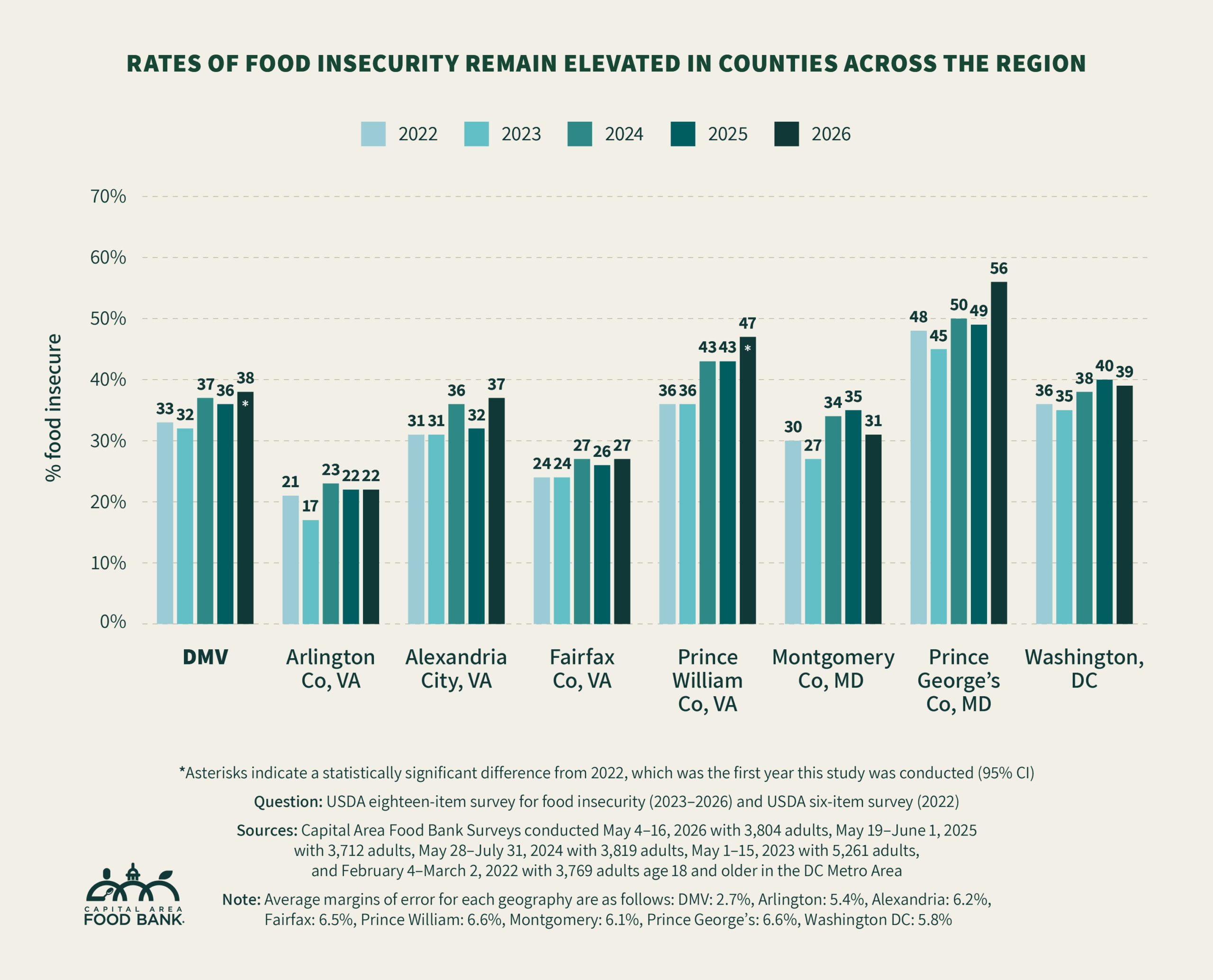
At the county level, prevalence rates for food insecurity also remain elevated, ranging from a low of 22% in Arlington, VA—still nearly one in four households—to a high of 56% in Prince George’s County.
As is the case regionally, rates of food insecurity at the county level are also trending upward over time. Among our area’s counties, the most significant increases over the course of the last five years of the CAFB-NORC study have been in Prince George’s and Prince William Counties. The 4-point decrease in food insecurity in Montgomery County over the last year, while within the margin of error, is also notable as an outlier in the region in terms of its negative trendline.
Rates of Food Insecurity Remain Elevated in Counties Across the Region Download chart

Trends in levels of food security
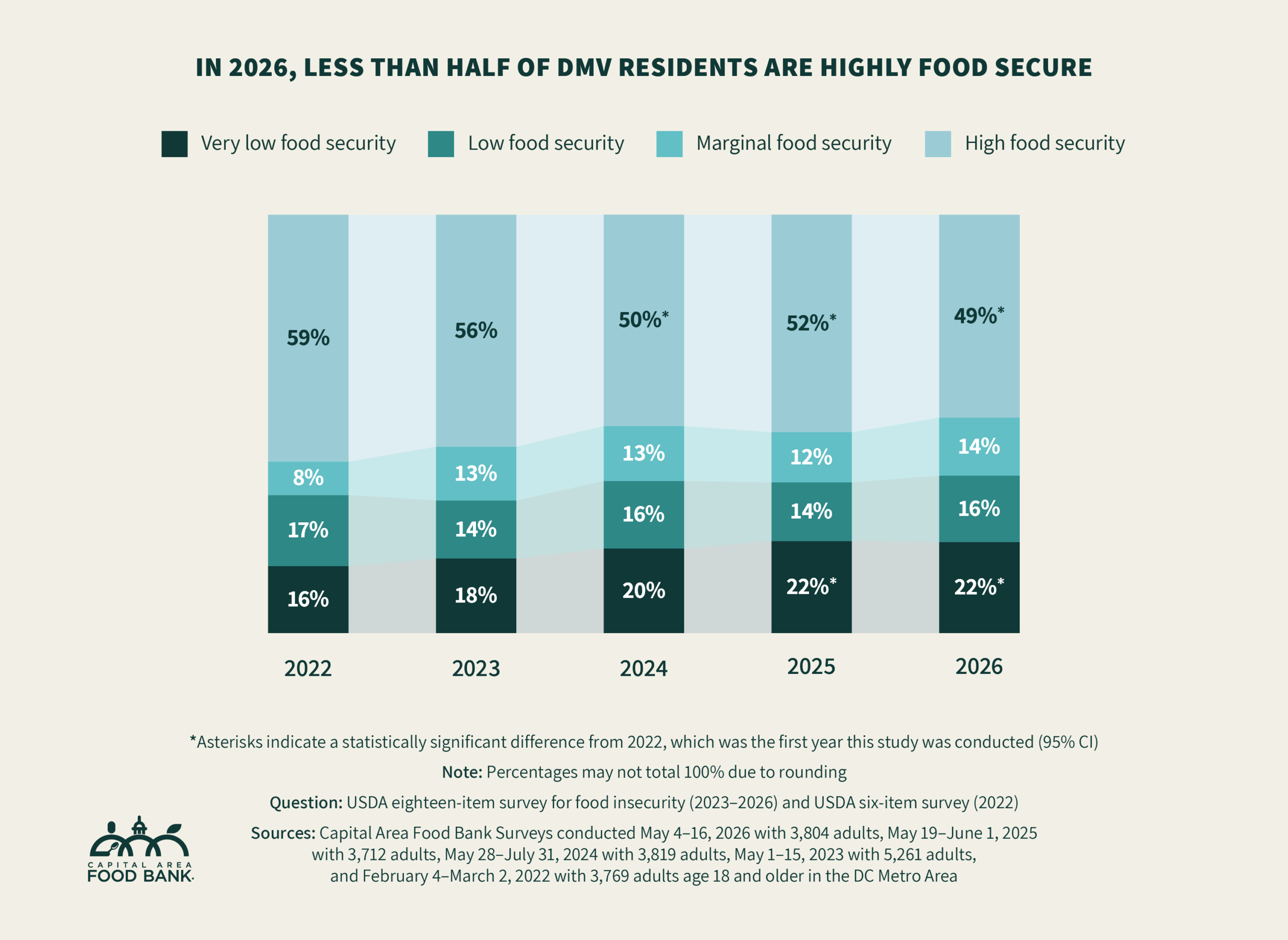
For the first time since the inception of the CAFB-NORC survey, fewer than half of DMV households are highly food secure.
Food security exists on a spectrum, ranging from high food security (those who rarely or never face uncertainty about whether or how they will secure enough nutritious food) to very low food security (those who experience this uncertainty—and the difficult decisions that come with it—far more often). Increasingly, the region’s overall food security is worsening when compared to 2022.
This year’s survey data show that for the first time since the inception of the CAFB-NORC survey in 2022, under half of DMV households were highly food secure, with rates dropping a full 10 percentage points since 2022. Over the same timeframe, very low food security—the most severe—increased significantly and remains elevated at 22%. These changes suggest that overall food security conditions have worsened over the past four years.
Rates of marginal and low food insecurity have ticked upward, and very low food security—the most severe—remains elevated at 22%.
In 2026, Less Than Half of DMV Residents are Highly Food Secure Download chart

Each level of food security corresponds to an increasingly constrained set of choices related to what and how much to eat. While households across the food security spectrum will occasionally need to stretch their food budgets, those at lower levels of food security face much more dire tradeoffs.
Households with Low or Very Low Food Security Face More Severe Challenges Download infographic

Insights into who is experiencing food insecurity
Food insecurity continues to disproportionately impact households with low income and people of color.
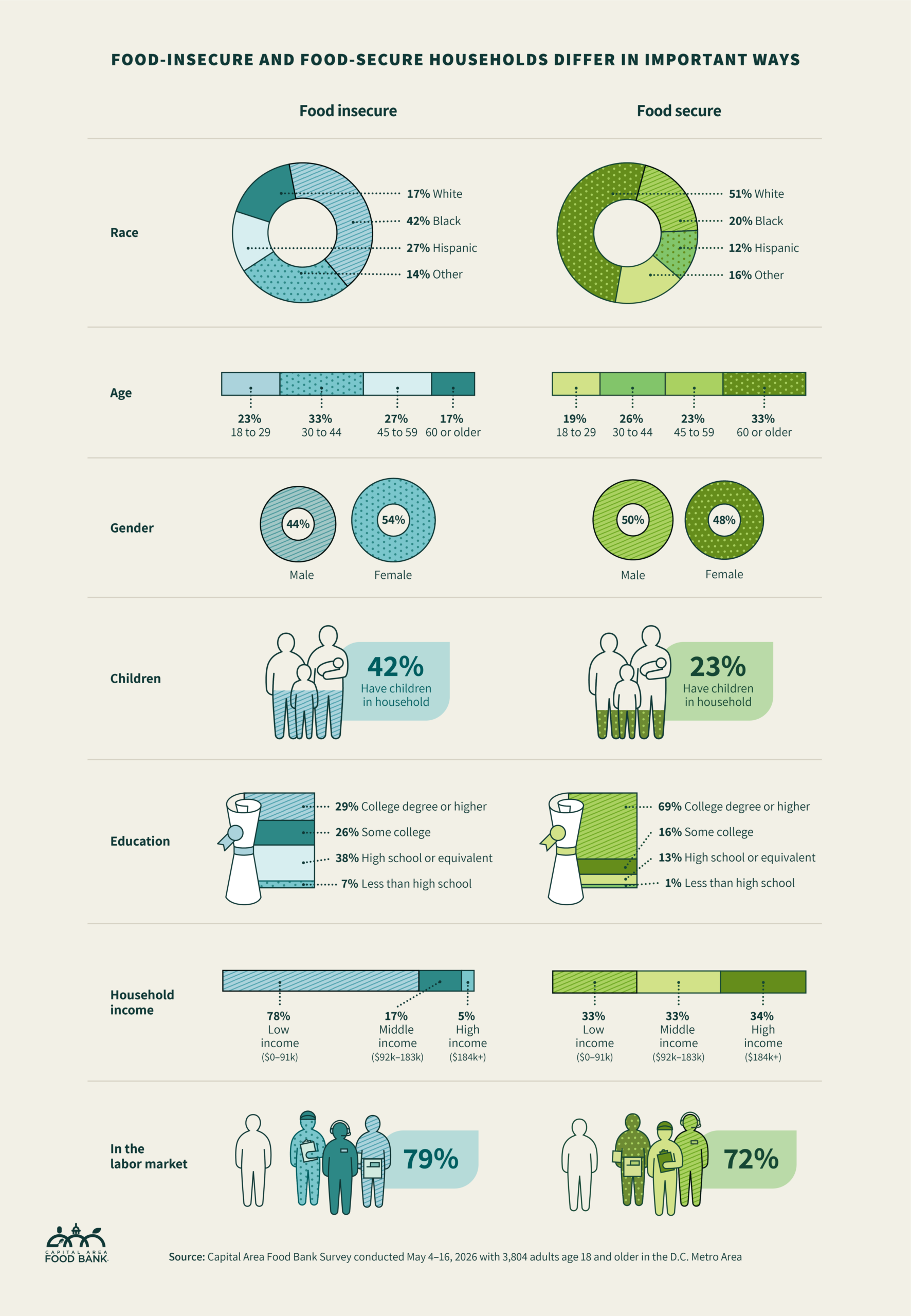
As in previous studies, the Capital Area Food Bank analyzed the demography and socioeconomic characteristics of the population experiencing food insecurity to gain a better understanding of which groups are most vulnerable. The findings of the 2026 survey are largely consistent with those in prior years: the food insecure population in the DMV is characteristically different from the food secure population across a variety of dimensions, including age, race, educational attainment, gender, and household structure.
Food-Insecure and Food-Secure Households Differ in Important Ways Download infographic

The most pronounced differences between the food secure and food insecure populations lie in the areas of income and race. The disproportionate prevalence of food insecurity among lower- and middle-income households, as well as households of color, is statistically significant and has held true over time. Since the first CAFB-NORC study in 2022, low-income and middle-income households have observed significantly higher levels of food insecurity than high-income households. In 2026, 3 out of 5 low-income households and even 1 out of 4 middle-income households were food insecure.
Food Insecurity Disproportionately Affects Lower- and Middle-Income Households in the DMV Download chart

Non-white households continue to experience rates of food insecurity 2–3 times higher than white households, and, as with food insecurity by income, the disparity is increasing.
Food Insecurity Disproportionately Affects People of Color in the DMV Download chart

Finally, food insecurity disproportionately affects households that include children. The CAFB-NORC survey includes a series of questions about food access among children in each household, and the 2026 survey found that approximately 34% of children in the DMV experienced food insecurity in the past year. This rate is typically lower than the rate for adults, as parents and caregivers will often sacrifice their own intake to ensure children are receiving sufficient food.
34% of children in the DMV experienced food insecurity in the past year.





Major Drivers of Food Insecurity
Food insecurity is closely tied to household financial stability, which in turn is shaped by broader economic conditions. Accordingly, an examination of the current state of the regional economy helps contextualize the pressures facing households across the DMV.
To be sure, there are several signs of strength in the DMV economy, including strong consumer spending (even among low-income households), strong GDP, strong business sentiments, and surprisingly resilient home prices. At the same time, other economic indicators are creating an increasingly mixed regional outlook. While unemployment and inflation are both low (4.0% for both), both have been rising for the last year. In the last year, the DMV has also experienced dramatic job losses, sharp increases in the cost of gasoline, and a cooling housing market.
The price of everything is high, sky high. Food, gas, just to breathe in general. Everything is high."
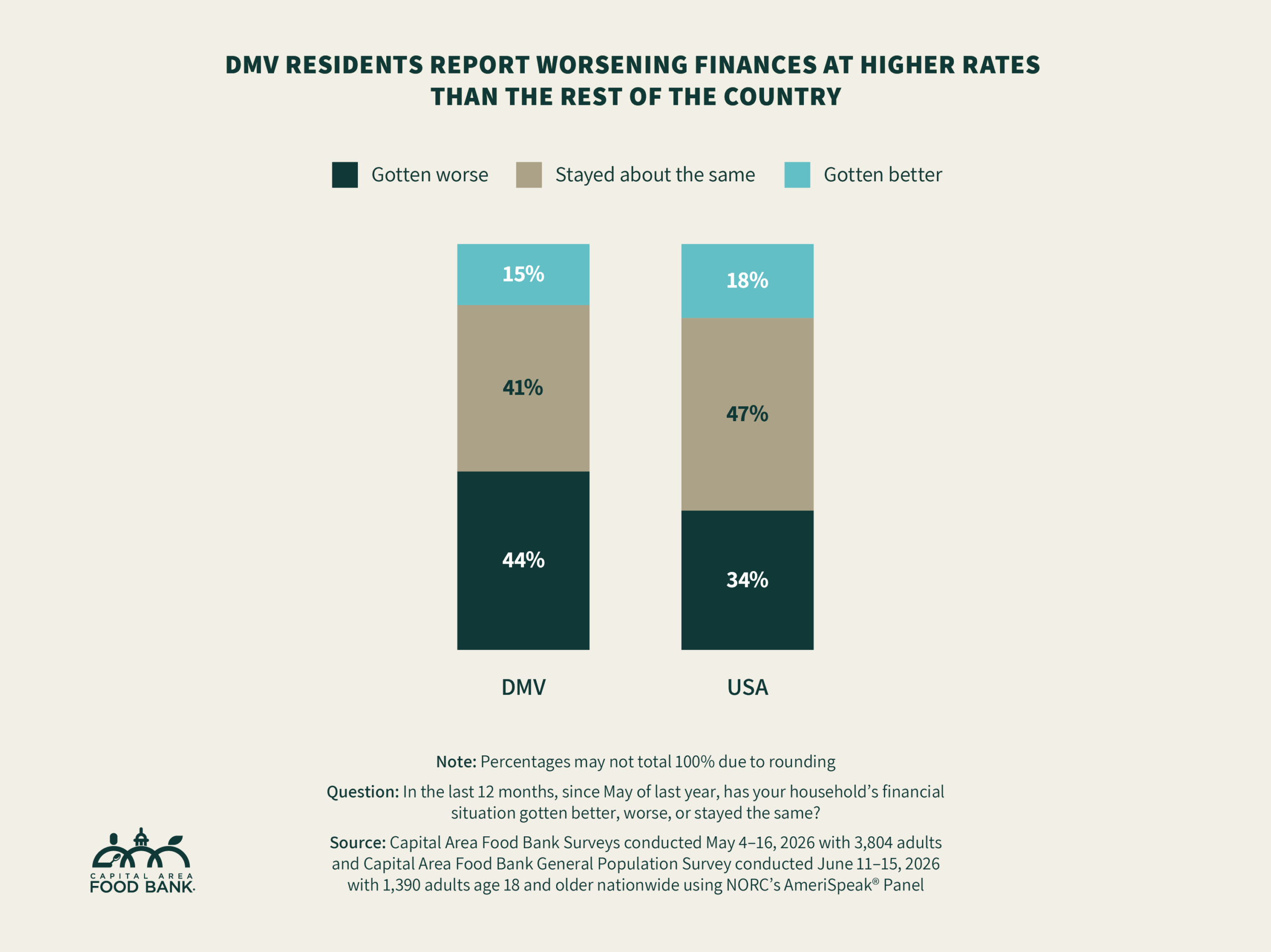
The financial experiences of survey respondents reflect these trends. In the CAFB-NORC survey, 44% of households reported that their financial situation got worse in the last 12 months, up from 40% in 2025 and 35% in 2024. These trends are even more pronounced for people of color, women, and households with low income, underscoring the diverging ways in which people across the region are experiencing the economy.
A Growing Share of DMV Households Report Their Finances are Worsening Year Over Year Download chart

While these trends represent broad economic conditions that are affecting the entire United States, the finding is more pronounced in the DMV than in the United States writ large. In 2026, the CAFB-NORC survey included a pulse survey with a representative sample of the entire country, which revealed that DMV residents’ finances are worsening at higher rates than the rest of the U.S.
DMV Residents Report Worsening Finances at Higher Rates than the Rest of the Country Download chart

In the DMV, respondents’ narratives reinforce the connection between broader economic pressures and household food insecurity. When asked in an open-ended question why their finances had gotten worse, respondents pointed to the overall economy, the cost of living, inflation, loss of employment, increased expenses—including housing, medical, and food costs—and difficulty finding a job.
Reasons for Household Financial Decline Relate Primarily to the Economy Download infographic
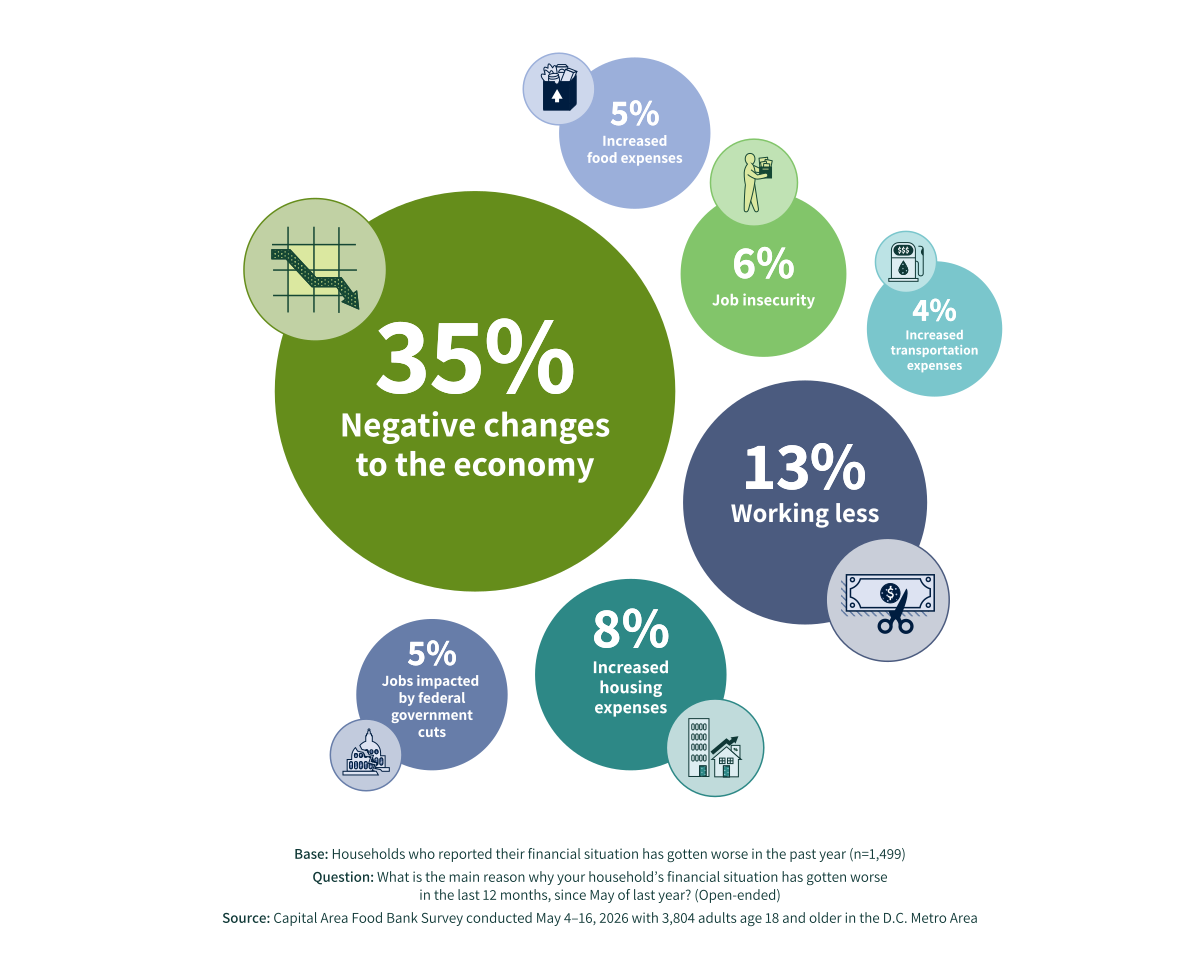
Collectively, these responses suggest that several forces are likely contributing to high food insecurity rates in the DMV, including a challenging employment landscape for some groups and inflation that has outstripped wage growth over time. These, along with impacts from the federal government shutdown, are explored in greater detail in the sections below.
Employment in the DMV
Federal budget cuts continue to negatively affect jobs and people’s ability to put food on the table.
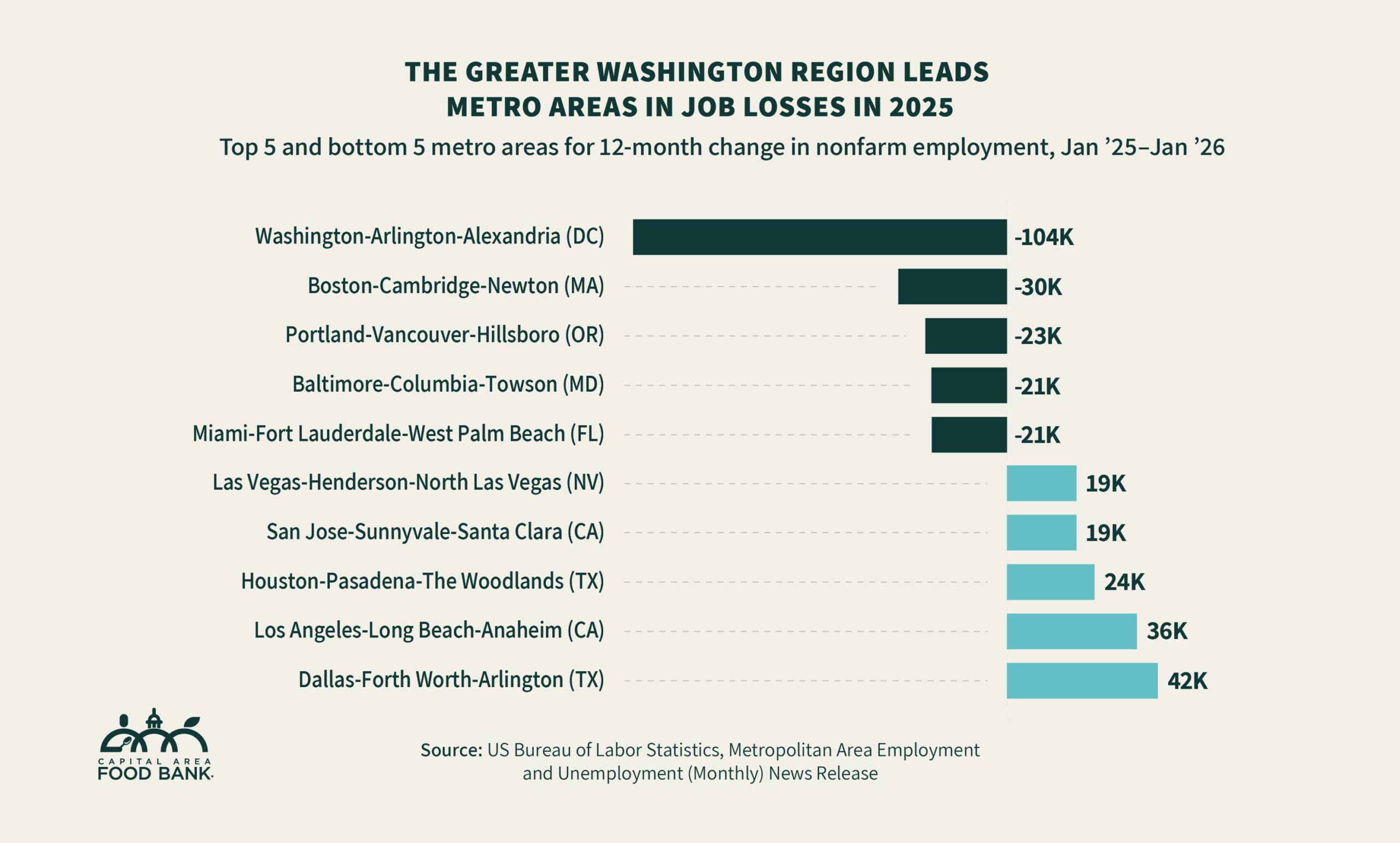
Federal employment and contracting have long been a source of regional economic stability. However, the Washington metropolitan area experienced an unusually difficult labor market during the past year, driven largely by changes in federal employment. Between January 2025 and January 2026, the region lost more jobs than any other major metropolitan area in the United States, with more than 100,000 positions disappearing during that period.
The Greater Washington Region Leads Metro Area in Job Losses in 2025 Download chart

While reductions in the federal workforce played a significant role in this outcome, the effects extended well beyond federal agencies themselves. A substantial decline in federal grants and contract spending also affected private employers and nonprofit organizations throughout the region as think tanks, universities, consulting firms, and defense contractors lost business, creating ripple effects across the broader labor market.
The consequences of these job losses continue to be felt by many households. Among survey respondents who reported that a member of their household had recently left employment with the federal government or a federal contractor, nearly half had not found new employment. Although some of these individuals retired, roughly one-third are still actively seeking work.
The consequences of these job losses continue to be felt by many households.
More than a Third of Workers Who Separated from the Federal Government in the Last Two Years Have Still Not Found Reemployment Download chart

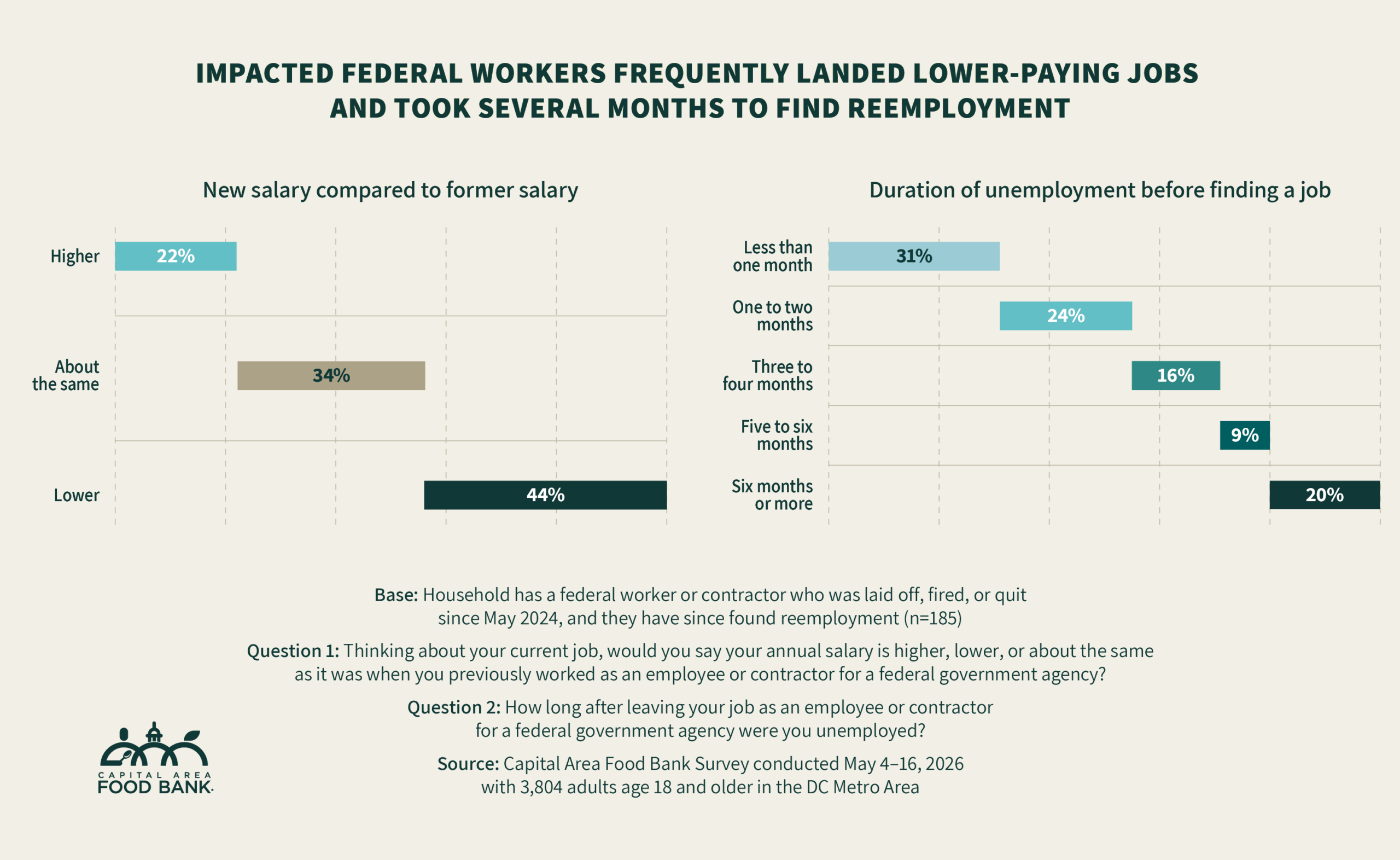
Even among those who successfully found new jobs, recovery has often been incomplete and slow. Nearly half reported earning less in their new position than in their previous role, and one in five said it took more than six months to become reemployed compared to the national median unemployment duration of about 11.4 weeks as of August 2026.
Impacted Federal Workers Frequently Landed Lower-Paying Jobs and Took Several Months to Find Reemployment Download chart

These employment disruptions have translated into elevated rates of food insecurity. As of May 2026 (about 15 months after the first major wave of workforce reductions), 33% of impacted federal workers were still food insecure—very similar to the proportion that is still seeking reemployment. Among those, the majority had “very low food security” status, indicating that employment shocks can have long-lasting consequences even after initial job losses occur.
After 20 years in the federal government, Quinnae lost her job due to broad reductions in the federal workforce last year. She has since found new employment, but she is still working to rebuild after relying on savings and the charitable food network to make ends meet.
Inflation & Cost of Living
Rising costs and lagging wages continue to erode purchasing power and strain household budgets.
Since 2019, the cost of living in the Washington metropolitan area has increased substantially. While wages also rose during and after the pandemic, cumulative wage growth has not fully kept pace with cumulative inflation in recent years. Since late 2023, increases in consumer prices have outstripped growth in average weekly earnings, meaning that many households can purchase less with their income than they could just a few years ago.
This erosion of purchasing power closely mirrors the upward trend in food insecurity observed in the CAFB-NORC survey. As household budgets become increasingly strained, food is often one of the most flexible expenses families can reduce, making food insecurity a common consequence of broader financial pressure.
In the DMV, Growth in the Consumer Price Index Has Outpaced Growth in Earnings in Recent Years Download chart

This trend of earnings lagging the Consumer Price Index (CPI) is especially pronounced in the Greater Washington region, where average weekly earnings have increased 18% since 2019, compared to 36% growth nationwide for the same period. At the national level, growth in average weekly earnings has slightly outpaced that of the CPI, in contrast to lagging it in the DMV.
Nationally, Growth in the Consumer Price Index and in Earnings are Closely Linked Download chart

Furthermore, the burden of rising costs has not been shared equally over the past year. National wage growth data suggest that lower-wage workers, who saw substantial wage gains during the pandemic years, have experienced slower earnings growth than higher-income workers since 2025. As a result, many lower-income households are finding it increasingly difficult to keep pace with rising prices for necessities.
In the Last Year, Low-Wage Earners Have Seen Slower Wage Growth Than Higher Wage Earners Download chart

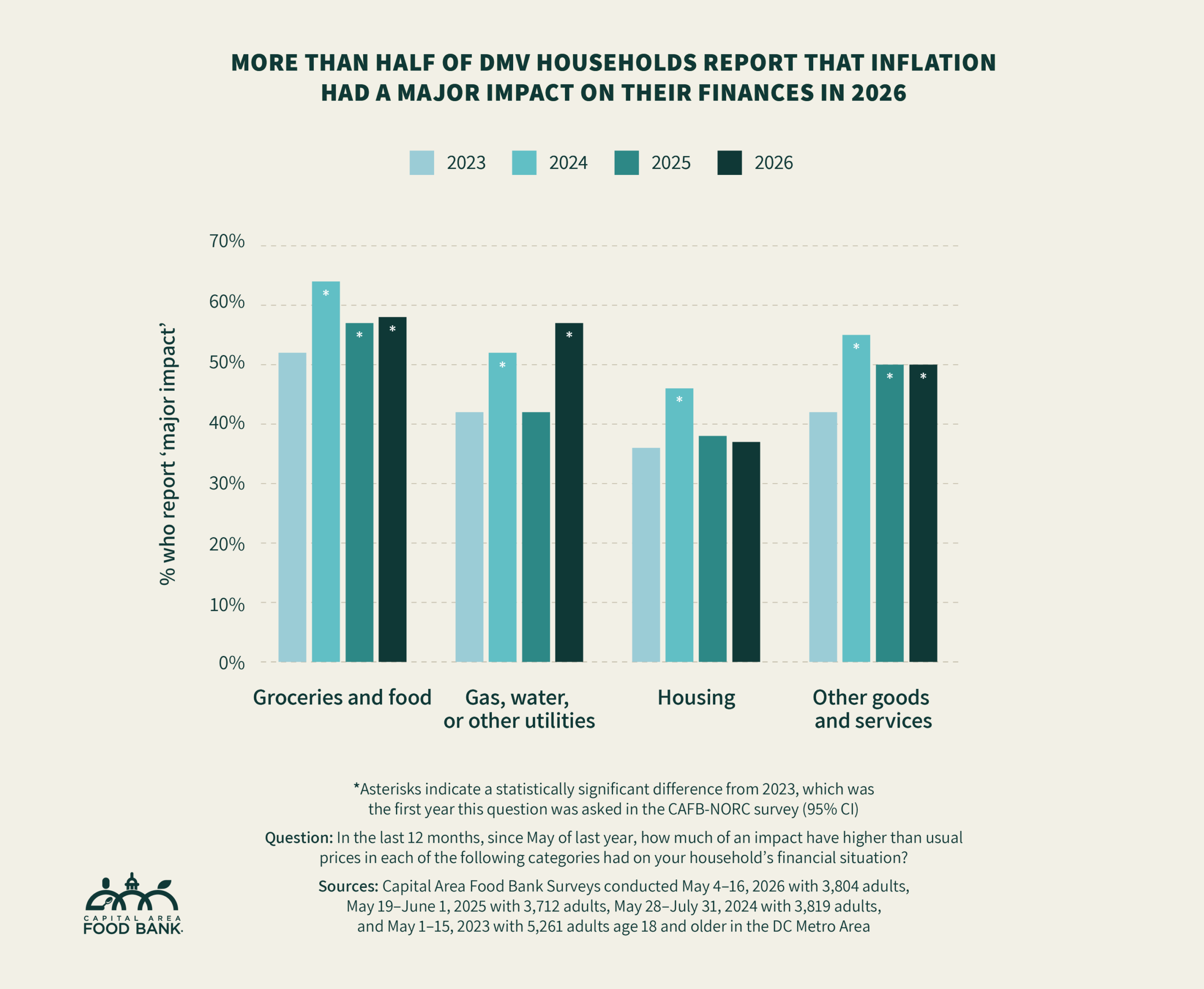
The effects of inflation are evident in households’ own descriptions of their financial challenges. More than half of DMV households reported that unusually high prices for food were having a major impact on their finances in 2026. Similar percentages cited rising utility costs and higher prices for other goods and services as causing major financial strain. Concern about gasoline prices increased particularly sharply compared with the previous year.
Mya is a single mom whose son has complex medical needs. Her car is essential to caring for him and rising gas prices have forced her to make difficult choices between transportation and food.
More than Half of DMV Households Report that Inflation had a Major Impact on their Finances in 2026 Download chart

To cope with these pressures, many households have adopted strategies that may provide short-term relief but can undermine long-term financial stability. Nearly six in ten households reported using savings to cover monthly expenses, while almost half said they were making only minimum payments on credit cards or other loans —findings reinforced by other studies on household financial wellbeing. One in five reported using Buy Now, Pay Later services or short-term installment plans to purchase groceries and food.
Households' Financial Coping Mechanisms Undermine Long-Term Financial Stability Download infographic

These survey findings are consistent with broader trends in household debt. Across the District of Columbia, Maryland, and Virginia, average personal credit card balances have risen steadily in recent years and are above the national average. Delinquency rates have also increased, suggesting that more households are struggling to keep up with financial obligations.
Credit Card Debt and Delinquency Have Risen in Recent Years Download chart

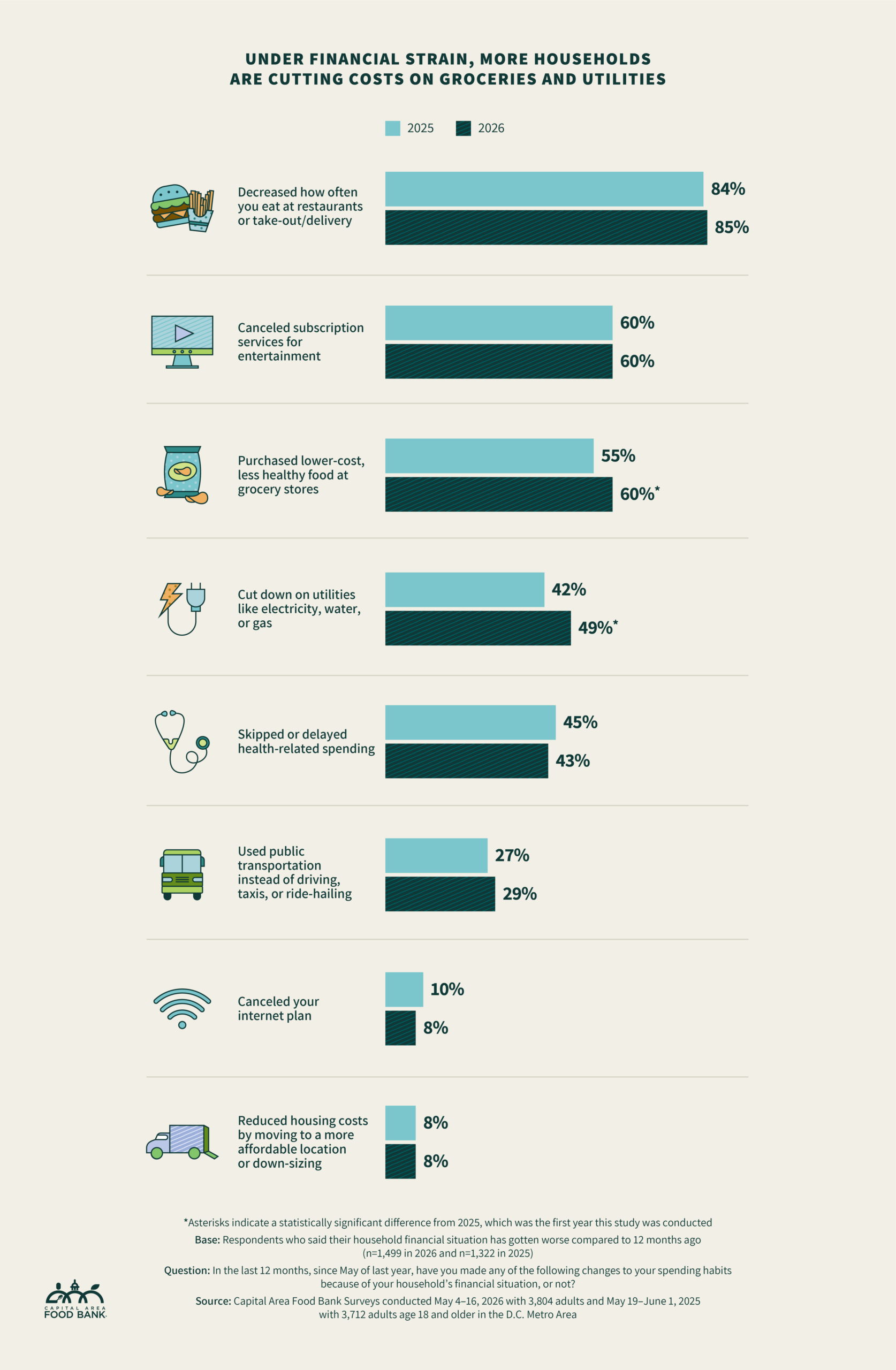
For households whose finances have worsened over the past year, these pressures are increasingly affecting day-to-day decisions. Compared with 2025, a larger share reported reducing utility usage to save money and purchasing lower-cost, less nutritious foods. These tradeoffs illustrate how financial strain, aside from affecting immediate wellbeing, can potentially result in adverse longer-term health outcomes.
Under Financial Strain, More Households are Cutting Costs on Groceries and Utilities Download infographic

Economic Pressures from the Federal Government Shutdown
The fall 2025 shutdown deeply affected the financial wellbeing of people across the region, with an outsized impact on lower income households.
Broader economic challenges were compounded by a historic 43-day federal government shutdown during October and November 2025. The shutdown created an additional financial shock for many households across the region, particularly given the DMV’s deep economic ties to the federal government.
Nearly half of all DMV households reported that the shutdown worsened their financial situation, with 13% describing the impact as significant. Although the shutdown affected many different types of households, its financial consequences were especially severe for families with one or more adults employed by the federal government or a federal contractor. Many were required to work without pay, while others were furloughed with no certainty that lost wages would ultimately be reimbursed.

The 2025 Government Shutdown had a Negative Financial Impact on Almost Half of DMV Residents Download chart

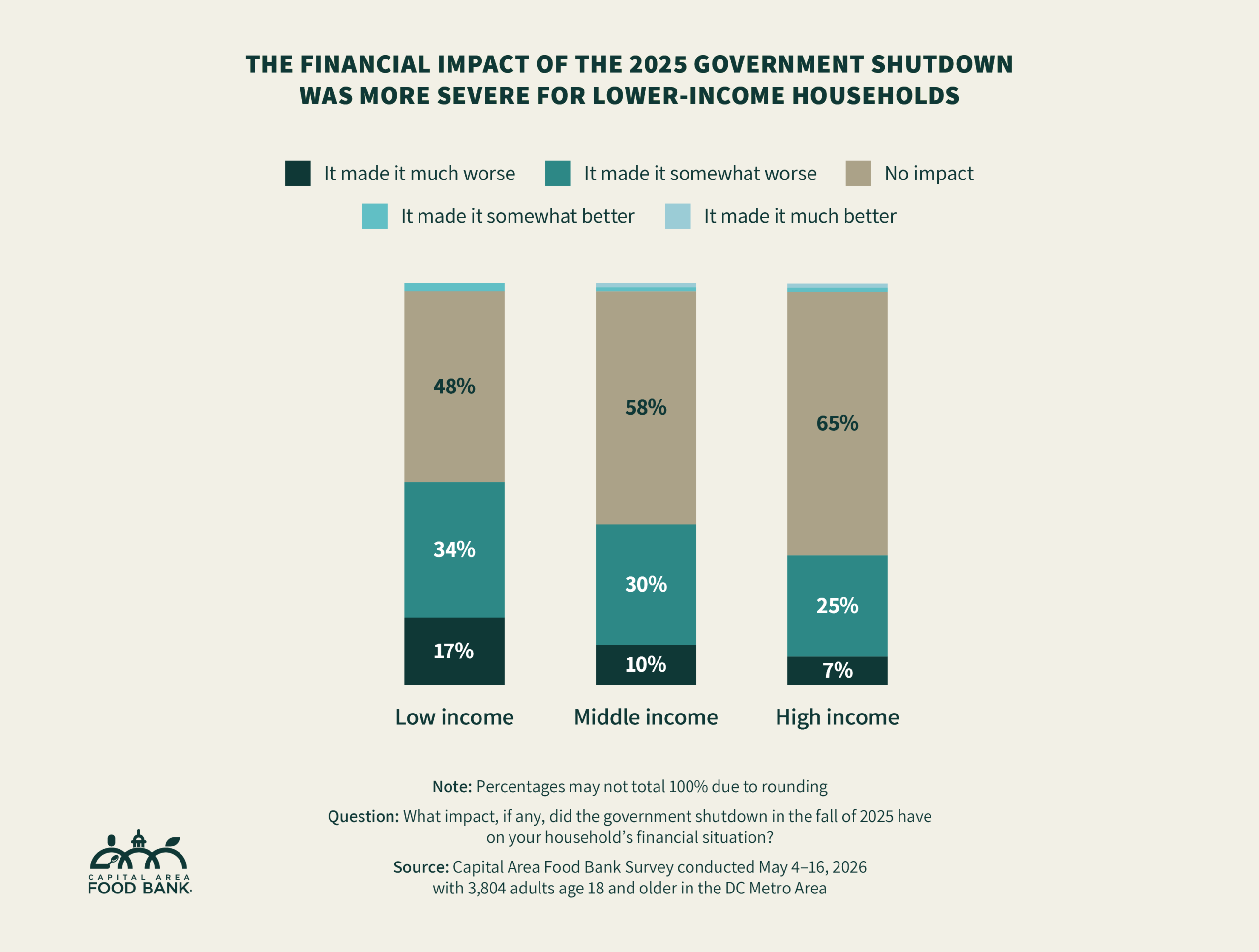
The effects were especially pronounced among lower-income households. Half of those in the bottom-third of the income spectrum—regardless of their employment by the federal government—reported that the shutdown made their finances worse, compared with roughly one-third of higher-income households. These findings continue to highlight how economic disruptions can disproportionately affect households that already have limited financial reserves and little capacity to absorb unexpected shocks.
The Financial Impact of the 2025 Government Shutdown was More Severe for Lower-income Households Download chart





Factors Poised to Compound Existing Need
The trends in food insecurity over the past five years documented in this report largely reflect the lingering effects of the pandemic, the expiration of temporary relief programs, persistent inflation that outpaced wage growth, and severe job losses in the Washington, DC region. However, there are additional—and extremely consequential—changes affecting the social safety net that are only now beginning to take shape. As a result, current estimates of food insecurity likely do not yet capture the full effects of several emerging forces that are expected to place additional strain on households already struggling to afford basic necessities.
Looking ahead, three developments warrant particular attention. Recent reductions to public benefit programs are expected to leave many households with fewer resources to meet their food needs. At the same time, charitable organizations are confronting growing financial and operational pressures that may limit their ability to fill those gaps. Finally, increased concerns among immigrant families about interacting with public systems may lead some eligible households to forgo assistance altogether, further exacerbating the scale of food insecurity challenges. While the magnitude of these impacts will unfold over time, together they point to a future in which food insecurity could continue to rise unless offset by new investments and effective interventions.
Impacts from cuts to social safety net programs
House Resolution 1 (H.R. 1) will significantly change benefit eligibility for thousands of people in the DMV area who rely on federal programs.
The Supplemental Nutrition Assistance Program (SNAP) is the nation’s largest federal nutrition assistance program. For nearly eight decades, it has helped eligible low-income individuals and families afford groceries and maintain access to a nutritious diet. It serves as a critical nutrition support for nearly 40 million people in the US—just over 400,000 of whom reside in the greater Washington region.
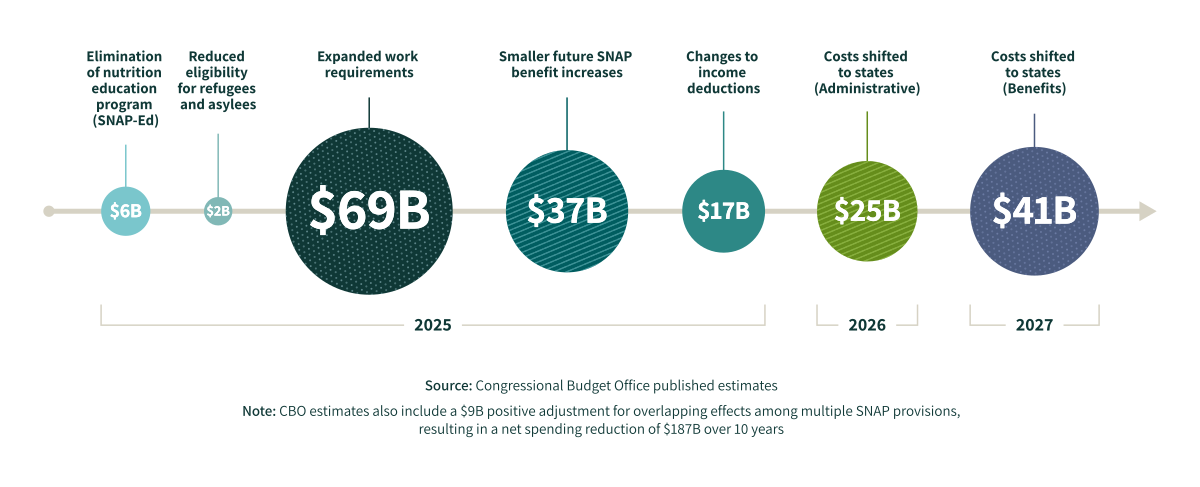
The legislation will make unprecedented cuts of around $187 billion to SNAP over 10 years—the largest in the program’s history.
Today, even as many residents of the region are facing mounting economic hardship, the program is in the process of undergoing a major contraction. House Resolution 1, which passed in July 2025, contained provisions that reduce federal spending, tighten eligibility, and shift costs and implementation responsibility for SNAP to states. The legislation will reduce federal spending on the program by around $187 billion (20%) over 10 years through a variety of measures. These reductions will be the largest in the program’s history.
H.R. 1 Cut $187B Out of Snap Over the Next 10 Years Download infographic
Changes to SNAP already in effect in Greater Washington
Some of the legislation’s changes have gone into effect already, or are just beginning to roll out, and will continue to have mounting impacts in the months and years ahead. These include:
-
Removal of SNAP access
for refugees and asylum seekers, which went into effect upon passage of the legislation.
-
More people subject to time limits for accessing SNAP:
Adults up to age 64 (formerly age 54) and parents of children ages 14+ (formerly ages 18+) are now subject to a 3-month time limit for receiving SNAP unless they document and report at least 80 hours a month of employment, volunteering, or training participation (or qualify for an exemption). Previous exemptions that existed for homeless individuals, veterans, and young adults aging out of foster care have been eliminated. These changes went into effect on November 1, 2025 in MD and VA, and on June 1, 2026 in DC (though the true impact of these changes begins after the three-month eligibility time limit runs out following the effective date).
-
Caps on future increases to the Thrifty Food Plan,
which is the basis for calculating SNAP benefits, through 2034. This limit prevents future benefits from keeping pace with the cost of maintaining a healthy diet over time.
-
Elimination of SNAP-Ed,
which provided access to nutrition education and healthy eating initiatives for SNAP participants.
Changes to SNAP still to come
To a large degree, the 2026 CAFB-NORC study could be considered a baseline before the majority of the provisions in H.R. 1 that will impact food security go into effect. In addition to the changes already implemented, others with potentially even greater impacts are still to come, including:
-
Greater administrative costs for all states:
A larger share of SNAP’s ordinary administrative costs—moving from 50% up to 75%—will be shifted to states, effective October 2026.
-
Benefit costs shifting to many states:
For the first time in the program’s history, many states will now be required to pay for a portion of SNAP benefit costs, effective October 2027 or later.
Taken together, these and other modifications to the program could make SNAP much harder for people in need across the region to access. According to a localized analysis conducted for CAFB by the Urban Institute using estimates from the Congressional Budget Office (among other sources), approximately 50,000 families — more than 10% of the current population receiving SNAP in the region — stand to lose an average of $187 in benefits per month when the provisions are fully implemented. With the average meal in our region costing $4.27, this amounts to a loss of about 40 meals per household per month.

Such changes also put significant new financial pressure on states and localities. While DC, Maryland, and Virginia have all indicated that they will allocate funds to cover the increased costs of administering SNAP in the upcoming year, these new expenses may force some state lawmakers to make difficult tradeoffs between other funding priorities that are important to the well-being of their residents.
These shifts in support are all coming at a time when many in our region are already struggling. Even before the majority of these provisions go into effect, individuals who receive SNAP have been experiencing increased financial difficulty over the past year. Those whose benefits stand to be reduced or eliminated may face even greater economic pressures.
According to the CAFB-NORC survey, 56% of SNAP recipients reported that their financial situation was already getting worse over the last 12 months. They also reported that they are already relying on a variety of financial coping strategies to make ends meet, including using savings to pay for monthly bills (71%); making minimum payments on credit cards (61%); and stopping saving for retirement or other future expenses (53%).
SNAP recipients reported making difficult tradeoffs between food and other expenses, like transportation, utilities and housing.
SNAP recipients also reported making difficult tradeoffs between food and other expenses, with 62% choosing between food and transportation, 58% choosing between food and utilities, and 51% choosing between food and rent or mortgage.
Even a partial loss of benefits stands to significantly impact those who turn to SNAP to help feed their households, and the charitable food network. When asked how they would cope if they lost up to half of their SNAP benefits, residents reported they would turn to charitable food to fill the gap, trade down in the quality and nutritional value of the food they purchase, and borrow money from friends or family to make ends meet.
Food Pantries Would be the First Line of Defense to Snap Cuts Download chart

While many of the largest impacts on SNAP discussed above are yet to come, program enrollment data suggest that some of H.R.1’s early effects may already be visible. Participation in SNAP has declined across all states over the past year. Between May of 2025 and May of 2026 (the most recent month for which federal data is available for all states), enrollment in SNAP has dropped by 13.5% nationwide. Enrollment has declined in all states served by the food bank, including DC (a decrease of 8,812 people, or 6.3%); Maryland (a decrease of 42,779 people, or 6.4%), and Virginia (the most significant decline, with a decrease of 120,278, or 14.6%).
SNAP Enrollment Has Declined 13.5% Across the U.S. in the Last Year Download chart
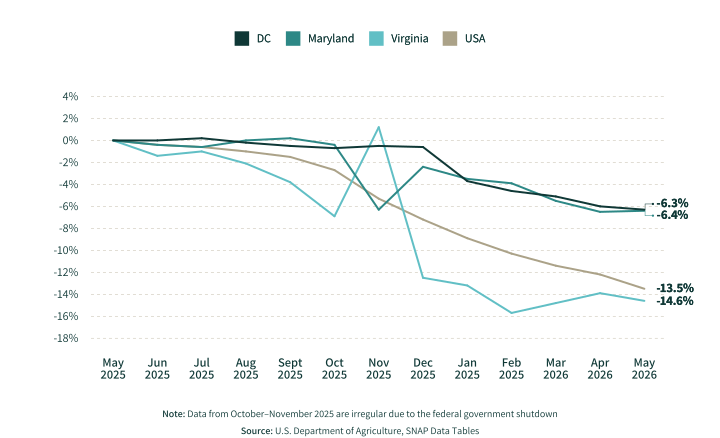
A variety of potential drivers exist for this decline, several of which may be connected to provisions in H.R.1. For instance, because the legislation dictates that states will soon be required to pay for a portion of SNAP benefits themselves based upon their rates of improper SNAP payments (which can happen for a variety of reasons), many states are working to quickly improve these error rates. This may be leading states to take actions that could result in delaying or denying benefits for greater numbers of people, even in cases where they may qualify.
H.R.1 changes could also be causing confusion among those who participate in SNAP—or are considering applying—about their eligibility, leading them not to re-certify or even attempt to sign up for benefits. Expansion of the groups subject to a 3-month time limit for receiving SNAP unless they meet certain exemption criteria or work requirements, for instance, have begun rolling out over the last year. This may be contributing to a lack of clarity among those who would otherwise seek to enroll in the program about whether they qualify.
20% of food insecure people who do not receive SNAP said the main reason they do not is because they are uncertain about their eligibility.
This is underscored by data in this year’s survey: 20% of food insecure people who do not receive SNAP said the main reason they do not is because they are uncertain about their eligibility. Additionally, federal analyses have shown that a substantial share of individuals who are eligible for SNAP are not enrolled. These findings suggest that actual eligibility restrictions are only part of the challenge, and that multiple barriers—including availability of and access to accurate information—continue to limit participation.
Eligibility Barriers—Whether Real or Perceived—Are the Top Reasons Food Insecure People are Not Enrolled in SNAP Download chart

It is unlikely that improving economic conditions are the driver behind lower SNAP participation. SNAP enrollment has historically moved in tandem with national rates of poverty and unemployment (with the exception of major economic disruptions), but national unemployment has been slowly increasing since 2023, even as SNAP enrollment declined. While official national data on poverty have only been released through 2024, monthly estimates of poverty by the Center on Poverty and Social Policy suggest that poverty rates in the United States have been largely stable through December 2025.
An increase in the number of households facing food insecurity but unable to access SNAP will have significant cascading effects. In addition to the immediate impact on the ability of these families and individuals to purchase adequate food, loss of SNAP may also impede some households from receiving other forms of assistance that use SNAP participation to establish automatic eligibility or simplify enrollment. For instance, losing SNAP may require additional applications or income verification to continue receiving benefits through programs such as free school meals, SUN Bucks, and other safety net programs—all of which could prevent people from participating even if they remain otherwise eligible.

These changes all stand to exert major pressure on organizations that provide food assistance. Before the passage of H.R. 1, the ratio of meals distributed by food banks to those distributed by SNAP was 1 to 9. The charitable food system will be many households’ first line of defense when contending with a loss of SNAP or other food benefits, but it cannot solve the problem: even if funding were increased, food banks cannot fully absorb the effects of these retractions and, in reality, funding for charitable food is declining. This topic is explored more deeply later in the report.
Compounding impacts from changes to Medicaid
Alongside changes to SNAP, H.R. 1 includes changes that will cut Medicaid funding by more than $930 billion over 10 years. As with SNAP, these are the largest cuts in the program’s history and will result in the loss of health insurance for more than 8 million people by 2034. According to estimates by the Kaiser Family Foundation, the three main jurisdictions in the CAFB’s service area, DC, Maryland, and Virginia, are expected to lose a combined $45.7 billion in funding for Medicaid over the next 10 years.
H.R. 1 also implements work requirements as a condition of eligibility for individuals ages 19–64 applying for coverage or enrolled through the Affordable Care Act Medicaid expansion group, requiring them to document and report work or qualifying activities for at least 80 hours per month. Medicaid work requirements are expected to lead to increases of at least 116,000 to the 309,000 individuals who are already uninsured across the DMV.
Changes under H.R. 1 have the potential to increase the number of people who lose both Medicaid and SNAP.
This loss of insurance is likely to have significant ripple effects. These include, most directly, major impacts on the health of those who are no longer covered and cannot afford the medical care they require. They also include economic ramifications: poorer health arising from a loss of coverage could impact employment and productivity, proving harmful to the financial situations of those impacted. Thousands of area residents who must now pay for medical treatment out of pocket may also face increased medical debt.
All of these financial risks and impacts stand to be even greater for the approximately 108,000 people in the DMV region who currently participate in both Medicaid and SNAP. Changes under H.R. 1 have the potential to increase the number of people who lose both Medicaid and SNAP because the same individuals may face similar administrative hurdles, work-reporting requirements, or changes in circumstances that affect their eligibility for both programs. In addition, because many states use integrated eligibility systems, losing Medicaid may trigger a review of SNAP eligibility that can uncover issues leading to SNAP closure—even in cases where the person is still technically eligible.
Combined, these changes are likely to contribute to greater hardship for tens of thousands of people across the area who currently depend on these programs, as well as reduce or eliminate support for those who may need help in the future if our regional economy weakens.
Increased Strain on the Charitable Sector
Charitable organizations face mounting challenges in the face of growing demand for their services.
The region’s charitable food network — anchored by the food bank and made up of pantries, houses of worship, schools, neighborhood-based nonprofits, and many other groups — is one of the DMV’s most important civic assets. These organizations hold a unique position with food insecure households and can respond to surges in need quickly, flexibly, and with local trust.
Accordingly, as economic pressures grow for many in the region, this network is playing an increasingly critical role in helping households cover their basic needs. Respondents to the CAFB-NORC survey who report attending charitable food distributions estimate that the food they receive offsets an average of $206 per month in grocery costs. For many households, this represents a meaningful share of their monthly food budget, underscoring the extent to which charitable food assistance is helping families absorb rising costs and avoid even greater financial hardship.
Reliance on charitable food has steadily increased across the DMV in recent years. In 2026, 28% of DMV residents reported receiving food from charitable sources such as food banks, food pantries, or community meal programs. While the charitable food sector alone cannot absorb the increase in demand for support that is expected as a result of H.R. 1, this marks a continuation of a longer-term trend toward greater reliance on charitable food assistance.
Utilization of Charitable Food in the DMV has Increased Over Time Download chart

Food security is defined as having reliable access to enough nutritious food to support an active, healthy life. For many households, charitable food assistance helps bridge the gap between limited financial resources and basic nutritional needs. In some cases, it prevents households from becoming food insecure altogether; in others, it reduces the severity of food insecurity that would otherwise occur.
8 percent of DMV households are currently food secure while also relying on charitable food assistance.
The survey data illustrate the extent to which charitable food is helping stabilize household food access. Approximately 8 percent of DMV households are currently food secure while also relying on charitable food assistance. Without these resources, many of these households would likely struggle to consistently obtain enough food for themselves and their families.
Food Insecurity and Charitable Food Use Exist on a Spectrum Download infographic

Demand for these services appears to be growing. Across the region, food pantries, meal programs, and other community organizations report seeing more people seek assistance as household budgets become increasingly strained.
Many of CAFB’s own network partners describe rising attendance at food distributions and growing demand from both long-time clients and households seeking help for the first time. Among the hundreds of nonprofit and faith-based organizations that partner with CAFB to distribute food across the DMV, 74% reported an increased number of individuals accessing food at their distributions in 2025. The populations driving that increase included seniors, people who are unemployed, and people who have lost access or experienced cuts in monthly government benefits programs.
Rob, executive director of Capital Area Food Bank partner Lorton Community Action Center, shares how the organization has tried new approaches to meet a 30% increase in people coming to its food pantry.
At the same time that demand is increasing, many nonprofit organizations are facing financial challenges of their own. Reductions in federal funding, uncertainty around government contracts and grants, and fiscal pressures affecting state and local governments have created a difficult operating environment for many social-service providers. Additionally, increased competition for non-federal grants and lower capacity for individual-level philanthropy among formerly employed workers are creating strain on the charitable sector.
Almost half of nonprofits headquartered in the DMV reported experiencing disruptions to government funding during the past year, according to a study by the Urban Institute. The study found that many organizations in the region have responded by pulling back from their missions, including reducing services, eliminating programs, slowing hiring, or planning staff reductions. Particularly for organizations that operate on thin margins, even temporary disruptions in funding can have significant consequences for their ability to serve communities.
At the same time that demand is increasing, many nonprofit organizations are facing financial challenges of their own.
The combination of rising demand and constrained organizational capacity presents a growing challenge for the region. If charitable food providers and other community-based organizations are forced to scale back services, households facing economic hardship may have fewer resources available to help them weather financial shocks. At a time when many families are already struggling to keep up with the cost of living, reductions in nonprofit capacity could leave more residents vulnerable to food insecurity.
Immigrant Families Opting Out of Support
Uncertainty and safety concerns are preventing many foreign-born individuals from seeking help for themselves and their families.
Another emerging concern is the growing number of immigrant households that appear to be disengaging from services and institutions that support health, financial stability, and food access.
Research from across the country suggests that immigration-related concerns are influencing how some families interact with public programs, community organizations, and everyday institutions. One recent study found that nearly 1 in 5 immigrant families avoided activities important to their wellbeing because of concerns related to immigration enforcement or status. These behaviors included avoiding health care, community events, work-related activities, and other aspects of daily life that support household stability.
In the Washington DC metropolitan area, 25% of the population is foreign-born, according to the Census Bureau. Of those, 40% were born in Latin America, 35% were born in Asia, and 16% were born in Africa. Nearly half of foreign-born individuals in the Greater Washington are non-citizens.
Nearly 1 in 5 immigrant families avoided activities important to their wellbeing because of concerns related to immigration enforcement or status.
Among foreign-born households in the DMV that are food insecure but not accessing charitable food assistance, many report barriers that extend beyond transportation or scheduling challenges. Concerns about safety, privacy, eligibility, and stigma all appear to play a role in keeping families from seeking help. Among the Capital Area Food Bank’s network of partners, 29% reported an increase in the number of individuals who accessed food via a proxy rather than attending themselves. Among the food bank’s own direct-to-community distribution programs, similar trends are taking hold as immigrant families opt out of attendance.
Community organizations throughout the region have observed similar patterns. Some food pantries and social-service providers that traditionally serve large immigrant populations report declines in participation despite continuing need within their communities. Staff and volunteers describe families becoming less visible in public spaces and more hesitant to engage with services that they previously used.
Joyce volunteers at a Capital Area Food Bank partner food pantry in Maryland. As concerns about immigration enforcement actions have kept some families from seeking help, the pantry has been finding new ways to reach neighbors whose need for food assistance has not gone away.
If these trends continue, food insecurity could rise among immigrant households even if food assistance remains available. When families withdraw from programs and services that help stabilize household finances and food access, they may become increasingly vulnerable to economic hardship. Ensuring that support-seekers feel safe, informed, and welcome when seeking assistance will be an important component of addressing food insecurity in the years ahead.


Recommendations
With regional food insecurity hovering near its highest levels since the height of the pandemic, the case for urgent, coordinated action is clear. Economic forces, coupled with major policy shifts, are having a significant impact on families across the region. It will take all sectors to address the challenges facing thousands of our neighbors, both in the immediate term and into the future.
Near-term actions to reduce hardship
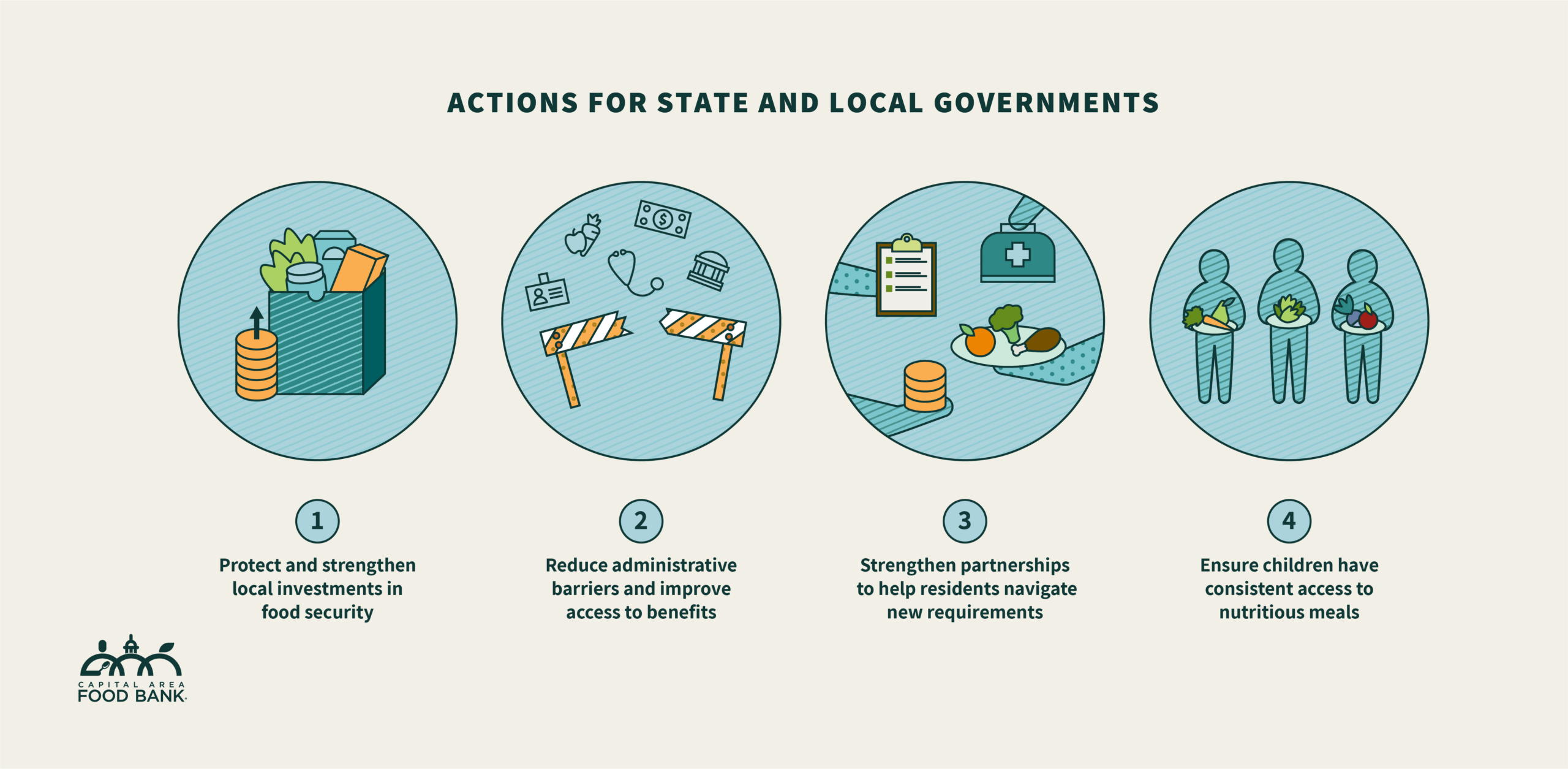
Actions for State and Local Governments Download chart

Protect and strengthen local investments in food security
As states prepare to assume a greater share of SNAP administrative costs (and, potentially, a portion of benefit costs based on payment accuracy), the region’s hunger relief organizations are also preparing to incur new costs stemming from rising demand for assistance. The Capital Area Food Bank, for instance, is increasing its annual distribution target to up to 75 million meals over the coming years – up from 66 million this past year. This requires additional food procurement, fuel, transportation, storage, and other expenses.
Addressing rising levels of need will require that policymakers plan for their own new cost obligations while preserving existing investments in food security. State and local leaders should protect current investments in the food-security infrastructure that communities rely on and be prepared to strengthen those investments as need grows. This includes the programs, partnerships, and community-based organizations that help residents access available benefits and provide food when those benefits are insufficient or unavailable. Investments should be targeted, measurable, and designed to reduce avoidable hardship before it becomes more costly for schools, hospitals, employers, and emergency-service systems.
Addressing rising levels of need will require that policymakers plan for their own new cost obligations while preserving existing investments in food security.
While charitable food providers can help families weather periods of hardship, they cannot replace the scale of support provided by SNAP. As federal support evolves, ongoing public investment in the regional food-security system will be essential to ensuring that households can continue to access nutritious food.
Reduce administrative barriers and improve access to benefits
As changes to SNAP and Medicaid introduce new eligibility requirements, reporting obligations, and renewal processes, state and local governments can help ensure that eligible residents are able to maintain access to critical benefits by reducing unnecessary administrative barriers. Building on existing efforts to modernize benefits systems, governments can continue improving online and phone-based options, strengthening coordination across programs, reducing avoidable errors, and ensuring that customers receive clear and timely information about program requirements. Regular feedback from residents, community-based organizations, and frontline service providers can help identify where processes create confusion or delays and inform practical improvements that make programs easier to navigate.
Strengthen partnerships to help residents navigate new requirements
As new SNAP and Medicaid requirements take effect, governments can work with trusted community organizations, workforce providers, and social service agencies to help eligible residents understand requirements, identify available exemptions, access supportive services, and complete necessary documentation. Community-based organizations often have established relationships with residents who may face barriers related to technology access, transportation, language, disability, caregiving responsibilities, or limited familiarity with government systems. Strengthening referral networks and investing in coordinated outreach can help ensure that residents who qualify for exemptions or other forms of support are able to access them.
Ensure children have consistent access to nutritious meals
Children’s access to nutritious meals should remain a priority as changes to public benefit programs affect families across the region. Governments can help ensure that children have reliable access to healthy food by strengthening school meal programs, expanding participation in child nutrition initiatives, and reducing administrative barriers that prevent eligible families from receiving available supports. Building on existing programs such as school meal access initiatives and summer nutrition programs can help ensure that children do not experience disruptions in food access because of changes in household circumstances or benefit eligibility.
Actions for the Charitable Sector Download chart

The changes enacted through H.R. 1 will place additional strain on households already struggling to meet their basic needs while increasing demand for charitable and community-based services. Although many organizations will work to expand their capacity in response, the scale of the challenge will require more than simply serving more people. It will also require making the existing network of supports easier to navigate, better coordinated, and more visible to the households that need it most. By reducing barriers to access and strengthening connections across services, the charitable sector can help blunt some of the impacts of reduced public assistance while improving the effectiveness of the broader safety net.
This work will require collaboration across food banks, food pantries, healthcare providers, schools, community-based organizations, philanthropy, and other trusted institutions. While each organization has a distinct mission, the households they serve often face the same interconnected challenges. Strengthening the pathways that connect people to available resources can help ensure that limited community investments reach more households and produce greater impact.

Help households access available benefits
First, organizations should expand efforts to help households understand and access public benefits. Even before the enactment of H.R. 1, many eligible individuals did not participate in programs such as SNAP because of confusion about eligibility requirements, difficulty navigating enrollment processes, or uncertainty about where to seek assistance. As program rules evolve, these challenges are likely to become even more pronounced. Investments in benefits navigation — including trusted community navigators, multilingual enrollment assistance, and partnerships with organizations specializing in public benefits outreach — can help ensure that households receive the assistance for which they remain eligible.
Build a more coordinated support system
Second, the charitable sector should make it easier for households to access multiple forms of support through coordinated service delivery. Food insecurity rarely exists in isolation; many households seeking food assistance also face challenges related to housing, transportation, childcare, healthcare, employment, or financial stability. Yet these services are frequently delivered through separate organizations with limited coordination. Strengthening referral networks, expanding warm handoffs between providers, and adopting “no wrong door” approaches can reduce the burden placed on clients while helping address the underlying factors that contribute to food insecurity.
Increase awareness of available resources
Finally, organizations should invest in increasing awareness of available resources. The findings presented in this report indicate that lack of awareness is the single most common reason food-insecure households do not access charitable food assistance, suggesting that many families who could benefit from available services simply do not know where to turn. Expanding culturally responsive outreach through trusted community institutions, healthcare providers, schools, employers, faith communities, and other local partners can help connect households with resources before financial hardship becomes more severe. In an environment where needs are growing and resources are increasingly constrained, ensuring that existing services are visible and accessible is itself an important strategy for reducing food insecurity.
Longer-term strategies to reduce food insecurity
Addressing food insecurity requires more than ensuring that people have enough food today. While charitable food assistance and public nutrition programs remain essential, lasting progress will depend on strengthening the systems that shape economic stability, health, and opportunity. Achieving that goal will require coordinated action across government, the private sector, healthcare, philanthropy, educational institutions, and community organizations. The following recommendations highlight two areas where cross-sector collaboration has the potential to improve both food security and broader wellbeing.
Strengthen economic mobility through basic needs supports
At a time when economic resilience has become an increasingly urgent priority for the Washington region, investments in workforce development have taken on renewed importance. As the region looks to diversify beyond its historic reliance on federal employment and contracting, workforce development can help ensure that residents who remain in the DMV are equipped to adapt to a labor market increasingly shaped by new industries, disrupted career paths, and changing skill requirements. Yet these efforts will fall short if they do not also address one of the most persistent barriers preventing many residents from advancing economically: the inability to consistently meet their basic needs.

As noted in previous Hunger Reports, many food insecure individuals are actively seeking opportunities for greater economic mobility but have encountered persistent challenges with employment, wage growth, and career advancement. The issue is not simply whether residents have access to workforce opportunities; it is whether they have the stability and support needed to successfully pursue them.
Food insecurity is both a symptom of economic hardship and a barrier to overcoming it. The financial strain of struggling to afford basic necessities can force difficult tradeoffs between meeting immediate needs and investing in long-term advancement. For adult learners, this may mean delaying enrollment in a training program, dropping out before completion, or being unable to accept an opportunity that requires short-term sacrifices in pursuit of future gains.
At the same time, the stress and health consequences associated with food insecurity can affect concentration, learning, and overall wellbeing, making it more difficult for individuals to succeed in educational and workplace settings. In this way, food insecurity is not only an indicator of economic vulnerability; it is an obstacle to building the skilled, resilient workforce the region needs.
For this reason, food security should be viewed as a foundational element of any economic development strategy. Just as transportation, childcare, and housing influence whether residents can access employment opportunities, food security helps determine whether individuals can fully participate in the education and training pathways that lead to living wage careers. Addressing basic needs is not separate from workforce development — it is what enables workforce development to succeed.
Food insecurity is not only an indicator of economic vulnerability; it is an obstacle to building the skilled, resilient workforce the region needs.
One opportunity to strengthen this connection is by expanding access to wraparound supports for adult learners pursuing new skills and credentials. Programs designed to help residents enter higher-wage careers are most effective when participants have the stability needed to complete them. Providing supports such as food assistance, housing resources, transportation assistance, and childcare can help individuals remain engaged in training programs long enough to achieve the economic gains those programs are intended to create.
Strengthen Economic Mobility through Basic Needs Supports Download infographic
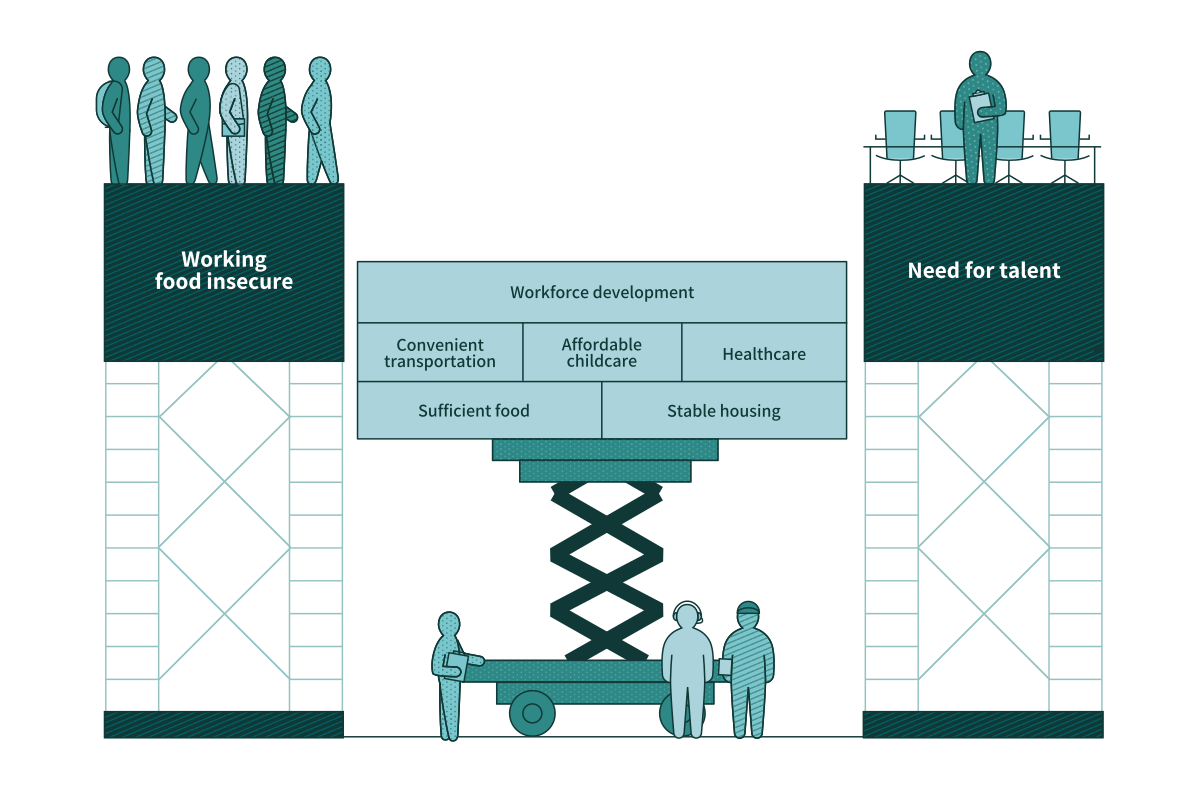
Achieving this vision will require collaboration across the region. Governments that invest in workforce development should apply a user-centered strategy and dedicate resources toward the basic needs supports that enable participants to persist and succeed. Employers, too, have an important role to play, because they benefit directly from a more stable talent pipeline. By partnering with workforce organizations, educational institutions, and community-based providers, employers can help design training pathways that align with real hiring needs while supporting the wraparound services that make it possible for their employees to meet their basic needs while training for those programs. Workforce developers, educational institutions, and nonprofit organizations can translate this vision into practice by identifying where participants are most likely to face barriers, coordinating referrals to food, housing, transportation, childcare, and other supports, and building those connections into program design from the outset.
The Capital Area Food Bank has been working to advance this model by partnering with community colleges and universities across the region to bundle free groceries with other academic and social supports for students pursuing workforce certificates, associate’s degrees, and bachelor’s degrees. These partnerships recognize that addressing immediate needs is not separate from helping individuals achieve long-term economic mobility; it is often the foundation that makes that mobility possible. CAFB’s partnerships also demonstrate that cross-sectoral, non-traditional partnerships are often the most effective at addressing deep-set challenges.
Scale Food is Medicine Programs Download chart

For several years, the Capital Area Food Bank has highlighted Food Is Medicine as a promising strategy for addressing two interconnected challenges facing the DMV: food insecurity and poor health outcomes. As this report has demonstrated, food security is not simply a question of whether people have enough food—it is also a question of whether they have consistent access to the nutritious foods needed to support their health and wellbeing.
Food security is not simply a question of whether people have enough food — it is also a question of whether they have consistent access to the nutritious foods needed to support their health and wellbeing.
Food insecurity and poor health exist in a reinforcing cycle. Diet-related illnesses such as diabetes, cardiovascular disease, and other chronic conditions can increase household financial strain through medical costs and reduced ability to work, while food insecurity itself can make it more difficult for individuals to access and afford nutritious foods. Breaking this cycle requires recognizing nutrition not as a separate social service issue, but as an essential component of healthcare and prevention.
In recent years, the Food Is Medicine field has made meaningful progress in demonstrating how targeted nutrition interventions can improve health outcomes. Healthcare providers, policymakers, and community organizations across the country have developed innovative models — including medically tailored meals and groceries, produce prescriptions, and nutrition education integrated into clinical care — that recognize food as a critical tool for prevention and treatment. National philanthropies have made major investments in FIM. Within the DMV, organizations across sectors have begun building partnerships to connect residents experiencing food insecurity with interventions designed to support their health.
Despite this progress, the opportunity to scale Food Is Medicine remains significant. Many programs continue to rely on limited-term grants or operate as individual pilots, preventing them from reaching the number of residents who could benefit. To fully realize the potential of these interventions, the region must move from isolated programs toward a more coordinated ecosystem in which healthcare providers, governments, payers, employers, philanthropy, and community organizations work together to integrate nutrition into the systems responsible for improving health outcomes.
The case for scaling this work has become more urgent as H.R. 1 begins to reshape the safety net. Reductions to SNAP and Medicaid could place new pressure on households that are already navigating both food insecurity and health challenges, while also straining the public and community-based systems that help them meet basic needs. Food Is Medicine programs cannot replace the core protections of nutrition assistance or health coverage, but they meaningfully reduce costs for a strained system and help families maintain steady progress towards better health. In that context, building a stronger regional Food Is Medicine ecosystem is both a health strategy and a food security strategy.
Several strategies can help advance this transition:
Develop sustainable funding pathways for Food Is Medicine interventions.
Expanding Food Is Medicine will require moving beyond short-term grants and creating durable financing models that recognize nutrition as an investment in health. State policymakers, healthcare payers, and health systems should explore opportunities to support evidence-based nutrition interventions through mechanisms such as Medicaid initiatives, managed care partnerships, state health transformation efforts, and private-sector investments. While all stakeholders in Food Is Medicine will need to be responsive to shifting funding landscapes, to enable these interventions to sustainably scale, continuous funding from multiple sources will be critical.
Strengthen the linkages between healthcare providers and community-based organizations.
Healthcare systems are increasingly recognizing food insecurity as a social determinant of health, but identification alone is not enough. Stronger systems that help healthcare providers refer patients with community organizations are needed to ensure that patients identified as food insecure are connected to reliable, nutritious food supports. These systems are critical for ensuring that patients get helpful referrals to organizations that can support them (and vice versa) and that those referrals are responded to in a timely manner.
Invest in the infrastructure needed to deliver and evaluate Food Is Medicine at scale.
Scaling these programs requires more than food alone. It requires investment in logistics, technology, data systems, evaluation, and the operational capacity needed to deliver consistent, high-quality interventions. When these systems are invested in, they can be built to close the loop for providers — ensuring referrals are tracked, services are confirmed, and outcomes flow back into clinical care — they create the administrative and logistical efficiencies that drive down costs and expand the capacity of community‑based organizations to deliver patient‑focused, reliable interventions.
The Capital Area Food Bank has supported more than 5,500 patients with nutrition-focused food interventions tailored to their needs.
While these improvements are critically needed, they are building on top of a robust infrastructure of community and health organizations that are already engaging in addressing these needs. There is a major opportunity to scale Food Is Medicine by fully leveraging the existing food bank network and expanding non clinic delivery models that bring services closer to where people live. These community based access points already reach households that face transportation barriers, irregular work schedules, limited clinic capacity, or discomfort engaging in traditional healthcare settings. By integrating FIM interventions into pantries, mobile distributions, home delivery routes, and other non clinical touchpoints, programs can dramatically extend their reach, reduce missed referrals, and ensure patients receive support quickly and consistently.
The Capital Area Food Bank has been working to advance this vision by partnering with healthcare providers across the region to deliver Food Is Medicine interventions to patients facing food insecurity and health-related challenges. Through these partnerships, CAFB has supported more than 5,500 patients with nutrition-focused food interventions tailored to their needs, while also partnering with independent evaluators to better understand the impact of these approaches. This work reflects the broader opportunity before the region: to recognize food not only as a basic need, but as a tool for improving health, strengthening communities, and creating a more resilient DMV.





















Conclusion
The economic challenges facing people across Greater Washington have entered a new and increasingly uncertain phase. As reductions in federal employment and spending continue to reverberate throughout the region, thousands of individuals and families are confronting job loss and financial instability at the same time that the cost of meeting basic needs continues to rise faster than many household incomes. For those already struggling to make ends meet, these pressures are compounding—and for many others, they are creating hardship and food insecurity.
The consequences extend well beyond the immediate challenge of putting food on the table. Without sufficient resources to consistently meet basic needs, individuals and families are increasingly forced to make difficult financial choices that can undermine their health, stability, and long-term economic security. And as more people experience these setbacks, the effects are felt throughout communities across our region.
The challenges ahead may be even more significant. The economic fallout from federal downsizing continues to affect people across the region, while the policies enacted through H.R. 1 will substantially reshape the systems that thousands of people in the area rely on when financial hardship strikes. As these changes take effect, they could reduce access to critical support at precisely the time when more households may need it—placing additional pressure on individuals, families, communities, and the organizations working to support them.
The trends outlined in this year’s report make clear that the path forward will require a coordinated response. Addressing the challenges facing our region will demand meaningful action to strengthen economic opportunity, protect access to essential resources, and ensure that people experiencing hardship are not left to navigate it alone. Through thoughtful policy, sustained investment, and a shared commitment across sectors, we can work to prevent today’s economic disruptions from creating deeper and more lasting inequities—and build a region where more of our neighbors have the stability and resources they need to thrive.